
March 25, 2020
Symposium On James Pfander, Constitutional Torts Together With The Country Of War On Terror

March 24, 2020
Call For Papers -- Constitutional History: Comparative Perspectives
Below the confine is the telephone band for papers for the tertiary annual conference on Constitutional History: Comparative Perspectives to endure held inwards Bologna, Italy on Nov thirteen & 14, 2017.
Paper proposals are invited for the Third Annual Illinois-Bologna conference on Constitutional History: Comparative Perspectives.
The conference volition endure held inwards Bologna, Italy, on Nov thirteen too 14, 2017.
The conference keynote speaker volition endure Giuliano Amato, Judge of the Constitutional Court of Italy, quondam Prime Minister of Italy, too Professor Emeritus of the European University Institute too the University La Sapienza.
Accompanying the spread of constitutional authorities to a greater extent than or less the basis has been a profound involvement inwards the comparative aspects of constitutional law. Scholars own got catalogued the differing features of national constitutions too examined how dissimilar constitutional systems resolve mutual legal issues. So, too, judges faced amongst legal questions own got sought guidance inwards the decisions of constitutional courts of other nations. While comparative constitutional police is thence a well-established field, less attending has been paid too then far to the comparative dimensions of constitutional history. This international conference aims to address that shortcoming past times energizing the written report too analysis of constitutional history from comparative perspectives. The conference has several interrelated goals. It volition supply a forum for presentation too give-and-take of electrical flow enquiry on issues of constitutional history that crosses national boundaries. Relevant topics inwards this regard include such things equally the origins of constitutional governments inwards dissimilar nations, changes inwards constitutional structures over time, comparative studies of the shifting roles of constitutional actors, the evolution of private rights inwards dissimilar systems, too the legitimacy too longevity of constitutions inwards diverse nations. The conference volition also choose together scholars who, at present, are working on constitutional histories of unmarried jurisdictions—with the expectation that conversations amid these scholars volition let for sharing of methodologies too indicate also to fresh areas of enquiry that may overstep national boundaries. In addition, the conference has relevance to the chore of judging. In some nations, notably the United States, constitutional history plays an of import too sometimes decisive purpose inwards the resolution past times courts of questions of constitutional law. The conference volition own got upward the house of constitutional history inwards constitutional adjudication. By comparison the practices of courts to a greater extent than or less the world, the conference volition line the own (or not) of constitutional history from the university to the courthouse too attempt the risks too benefits of modern practices.
Scholars interested inwards presenting a newspaper at the conference should email a championship too summary of the proposed newspaper along amongst a CV to Professor Jason Mazzone at mazzonej[@]illinois.edu. Proposals received past times July 1, 2017, volition have priority. After that date, submitted proposals volition endure considered exclusively if infinite remains.
Conference participants are responsible for their ain locomote too accommodation expenses.
Call for Papers
Constitutional History: Comparative Perspectives
Bologna, Italy
November thirteen & 14, 2017
Sponsored by:
University of Illinois College of Law
University of Bologna School of Law
Center for Constitutional Studies too Democratic Development
Paper proposals are invited for the Third Annual Illinois-Bologna conference on Constitutional History: Comparative Perspectives.
The conference volition endure held inwards Bologna, Italy, on Nov thirteen too 14, 2017.
The conference keynote speaker volition endure Giuliano Amato, Judge of the Constitutional Court of Italy, quondam Prime Minister of Italy, too Professor Emeritus of the European University Institute too the University La Sapienza.
Accompanying the spread of constitutional authorities to a greater extent than or less the basis has been a profound involvement inwards the comparative aspects of constitutional law. Scholars own got catalogued the differing features of national constitutions too examined how dissimilar constitutional systems resolve mutual legal issues. So, too, judges faced amongst legal questions own got sought guidance inwards the decisions of constitutional courts of other nations. While comparative constitutional police is thence a well-established field, less attending has been paid too then far to the comparative dimensions of constitutional history. This international conference aims to address that shortcoming past times energizing the written report too analysis of constitutional history from comparative perspectives. The conference has several interrelated goals. It volition supply a forum for presentation too give-and-take of electrical flow enquiry on issues of constitutional history that crosses national boundaries. Relevant topics inwards this regard include such things equally the origins of constitutional governments inwards dissimilar nations, changes inwards constitutional structures over time, comparative studies of the shifting roles of constitutional actors, the evolution of private rights inwards dissimilar systems, too the legitimacy too longevity of constitutions inwards diverse nations. The conference volition also choose together scholars who, at present, are working on constitutional histories of unmarried jurisdictions—with the expectation that conversations amid these scholars volition let for sharing of methodologies too indicate also to fresh areas of enquiry that may overstep national boundaries. In addition, the conference has relevance to the chore of judging. In some nations, notably the United States, constitutional history plays an of import too sometimes decisive purpose inwards the resolution past times courts of questions of constitutional law. The conference volition own got upward the house of constitutional history inwards constitutional adjudication. By comparison the practices of courts to a greater extent than or less the world, the conference volition line the own (or not) of constitutional history from the university to the courthouse too attempt the risks too benefits of modern practices.
Scholars interested inwards presenting a newspaper at the conference should email a championship too summary of the proposed newspaper along amongst a CV to Professor Jason Mazzone at mazzonej[@]illinois.edu. Proposals received past times July 1, 2017, volition have priority. After that date, submitted proposals volition endure considered exclusively if infinite remains.
Conference participants are responsible for their ain locomote too accommodation expenses.
March 23, 2020
Constitutional Rot As Well As Constitutional Crisis
No i could accuse Donald Trump’s presidency of beingness boring. The showtime hundred days receive got careened wildly through scandals, revelations, outrages, as well as fracturing of political norms. Every fourth dimension Trump does something remarkable, similar the recent firing of Director James Comey, pundits inquire post, constitutional crisis refers to something different: Influenza A virus subtype H5N1 constitutional crisis occurs when in that place is a serious danger that the Constitution is nigh to neglect at its cardinal chore of keeping disagreement inside the boundaries of ordinary politics instead of breaking downward into lawlessness, anarchy, violence, or civil war.
As Sandy Levinson as well as I receive got explained, there are iii types of constitutional crises. In Type One crises, political leaders denote that they volition no longer abide yesteryear the Constitution or laws (for example, because of emergency), or they openly flout judicial orders directed at them. In Type Two crises, people follow what they believe the Constitution requires, leading to political paralysis or disaster. In Type Three crises, political disagreement nigh the Constitution becomes as well as thence intense that the scrap goes beyond the bounds of ordinary politics. People accept to the streets; in that place are riots; the armed services is called out to restore monastic tell (or suppress dissent); political figures threaten violence or engage inwards political violence; or parts of the the world revolt and/or travail to secede,
Constitutional crisis is really rare, as well as null that has nonetheless happened inwards the Trump Administration -- including the Comey firing-- comes fifty-fifty close. But people are correct to recall that something important-- as well as dangerous--is happening to our political institutions. That is why, I think, people as well as thence oft achieve for the term "constitutional crisis" to depict it.
In this essay, I wish to innovate a novel thought to explicate our electrical flow predicament. I volition distinguish constitutional crisis, which is really rare, from a unlike phenomenon, which I recall ameliorate describes what is happening inwards the US today. This is the thought of constitutional rot.
Although the Comey firing is non an instance of constitutional crisis, it is an instance of constitutional rot. For this reason, people are correct to worry nigh it.
I. Constitutional Rot: Decay inwards the Norms as well as Institutions that Support Democracy
What is the divergence betwixt constitutional crisis as well as constitutional rot? Constitutional crisis could, inwards theory, take house to whatever constitution; constitutional rot is a specific malady of constitutions of representative democracies—that is, republics. Constitutional crisis occurs during relatively brief periods of time; constitutional rot is a degradation of constitutional norms that may operate over long periods of time.
What is constitutional rot? Democratic constitutions depend on to a greater extent than than obedience to law. They depend on well-functioning institutions that residual as well as cheque powerfulness as well as ambition. These include non entirely populace institutions but institutions of civil social club similar the press.
Next, democracies depend on the public’s trust that authorities officials volition do powerfulness inwards the populace involvement as well as non for their ain personal do goodness or for the do goodness of individual interests as well as cronies.
Democracies also depend on forbearance on the share of populace officials inwards their assertions of power, as well as obedience to norms of fair political competition. These norms forbid ambitious politicians from overreaching as well as undermining populace trust. These norms assistance to promote cooperation betwixt political opponents as well as factions fifty-fifty when they disagree strongly nigh how to principle the country. Finally, these norms forbid politicians from privileging brusk term political gains over long term injuries to the wellness of the constitutional system.
When politicians disregard norms of fair political competition, undermine populace trust, as well as repeatedly overreach yesteryear using constitutional hardball to rig the organization inwards their favor, they get the organization of democratic (and republican) constitutionalism to decay. This is the phenomenon of constitutional rot.
The thought of constitutional rot is really old. The political theory of republicanism familiar to Constitution’s founders asserted that republics were fragile institutions that were ever susceptible to decay as well as corruption over time. Time was the nifty enemy of republics, because ever-changing circumstances, as well as the driving forcefulness of people’s ambitions as well as wish for powerfulness would opened upward the door to—if non encourage—multiple forms of institutional corruption. In modern democratic republics, this institutional corruption is a version of constitutional rot.
II. The Dangers of Constitutional Rot
Constitutional rot creates ii serious risks to democratic politics. First, yesteryear playing every bit good much hardball, demonizing their opposition, as well as attempting to vanquish those who stand upward inwards their way, political actors take a opportunity increasing as well as widening cycles of retribution from their opponents. This may atomic number 82 to deadlock as well as a political organization that is increasingly unable to principle effectively.
Second, undermining or destroying norms of political fair play as well as using hardball tactics to preempt political contest may create a gradual descent into authoritarian or autocratic politics. Such states may save the empty course of report of representative democracy—they may receive got written constitutions as well as regular elections; as well as they may adhere for the most share to the dominion of constabulary formalities. But powerfulness is increasingly concentrated as well as unaccountable; the press, civil society, political opponents, civil servants as well as the judiciary no longer serve every bit independent checks on the powerfulness of the people inwards charge. Indeed, political leaders may systematically seek to weaken or co-opt each of these possible sources of opposition. These features of constitutional rot are probable to atomic number 82 to increasing corruption, overreaching, as well as suppression of basic liberties. Regimes that slide into autocracy or authoritarianism may non endure constitutional crises inwards the feel that they are politically stable as well as successfully avoid civil unrest or civil war. But they receive got failed every bit democratic constitutional systems; increasingly they are democracies inwards advert only.
Obviously these ii risks—deadlock as well as descent into autocracy—are related. Influenza A virus subtype H5N1 organization that has teach as well as thence deadlocked that politics seems futile may atomic number 82 to the election of demagogues as well as authoritarian minded politicians who undermine democratic norms as well as atomic number 82 a patch toward autocracy.
There are of import literatures emerging on these questions inwards political science, including the report of constitutional retrogression. (This is an opening contestation of a larger projection they are working on, How to Lose a Constitutional Democracy.) All of these ideas are related to what I am calling constitutional rot.
Lest I live misunderstood, I am not claiming that the US has already slid into autocracy, or that nosotros receive got already produced anything similar the democratic backsliding nosotros encounter inwards Republic of Hungary or Turkey. Our institutions stay far to a greater extent than robust. And indeed, every bit the incurable optimist that I am, I believe that our democratic institutions are resilient plenty to force dorsum against the depredations of a demagogue similar Trump. But what many Americans increasingly sense, I think, is that our democratic institutions are decaying and/or are nether assault. If null is done to halt the decay, nosotros volition eventually live inwards really large trouble.
III. How Constitutional Rot Relates to Constitutional Crisis
What is the human relationship betwixt constitutional crisis as well as constitutional rot? The ii phenomena are non identical. As noted above, the inquiry of constitutional crisis concerns whether the constitutional organization tin perform its cardinal share of making politics possible—keeping struggles for powerfulness inside politics as well as preventing violence, insurrection, as well as civil war. The iii types of constitutional crises listed higher upward tin occur inwards many unlike kinds of systems, whether democratic or not. Constitutional rot, yesteryear contrast, is a characteristic of constitutional democracies as well as republics—it concerns how these systems degrade into deadlock as well as despair on the i hand, or into authoritarianism as well as autocracy on the other.
There is or as well as thence other of import distinction. The thought of “crisis” refers to a crucial minute inwards time—usually rather brief inwards duration—in which the constitutional organization volition adequately reply to a challenge, live undermined, or live successfully reconstituted. Constitutional rot, yesteryear contrast, is oft a long as well as slow procedure of alter as well as debilitation, which may live the piece of work of many hands over many years. Crisis seems to come upward upon us suddenly—it focuses everyone’s attending on the spectacle. Rot develops slow as well as gradually as well as may live imperceptible inwards its earliest stages; sometimes features of constitutional rot are obvious, but sometimes they operate quietly inwards the background.
Even so, the ii phenomena are connected. Continued constitutional rot inwards a democratic organization may live the harbinger of a constitutional crisis years later. In his 2015 book, Broken Trust: Dysfunctional Government as well as Constitutional Reform, Steven Griffin has argued that the most of import rootage of constitutional dysfunction inwards the US is increasing loss of populace trust amid citizens. This loss of trust did non occur overnight; it is the final result of decades of fateful decisions yesteryear political actors seeking short-term political success, stoking political polarization to win elections, as well as playing political hardball to lock inwards greater powerfulness as well as reduced accountability. Griffin regards this every bit a assort of “slow-motion” constitutional crisis. I would say that it is a description of constitutional rot.
Constitutional rot inwards a republic involve non ever atomic number 82 to constitutional crisis. It mightiness exactly atomic number 82 to a less exactly as well as less democratic organization of government. This is what happens inwards slides to autocracy. Nevertheless, constitutional rot, if unchecked, tin atomic number 82 to a constitutional crisis, exactly every bit placing increasing weight on a rotten tree branch tin eventually get it to snap. Indeed, constitutional rot tin atomic number 82 to whatever i of the iii types of constitutional crisis that Levinson as well as I described.
Politicians may publicly decline constitutional obligations. (Type One). The organization may endure severe crises of governance inwards which the province is unable to perform basic functions (Type Two). Finally, loss of populace trust combined amongst the rising of political opportunists as well as demagogues who stoke anger as well as resentment inwards their followers (or inwards their opponents) may create cycles of political violence, or fifty-fifty insurrection (Type Three).
Constitutional rot, inwards other words, tin eventually get a democratic constitution to neglect both every bit a *democratic* constitution—because the organization degenerates into autocracy; as well as every bit a democratic *constitution*— because the constitution no longer tin hold political disagreement inside the bounds of constabulary as well as peaceful political dispute.
My persuasion is that nosotros are non currently inwards a menstruum of constitutional crisis. But for or as well as thence fourth dimension nosotros receive got been inwards a menstruum of increasing constitutional rot. The election of a demagogue similar Trump is evidence that our institutions receive got decayed, as well as judging yesteryear his presidential get as well as his showtime hundred days inwards office, Trump promises to accelerate the corruption.
IV. Understanding the Comey Firing inwards Terms of Constitutional Rot
Similarly, Trump’s firing of James Comey was non inwards itself a constitutional crisis, because the President legally has the say-so to burn the FBI Director. It happened i time before, when Bill Clinton fired Director William Sessions because of ethics violations. Comey’s firing is non a constitutional crisis. Trump has non asserted (for example) that he is deliberately acting exterior the Constitution.
Rather, Comey’s firing is a symptom of constitutional rot, as well as people receive got been employing the linguistic communication of constitutional crisis to depict it. This problem, I think, is related to what Steven Griffin meant when he suggested that nosotros are inwards a “slow motion” constitutional crisis, i ultimately caused yesteryear lack of populace trust inwards government.
Many Americans no longer trust authorities to human activity inwards the populace interest, as well as many politicians human activity inwards ways that encourage their lack of trust. President Trump has violated many preexisting political norms, as well as our increasingly polarized politics has caused the nation’s ii political parties to force the envelope through diverse forms of constitutional hardball. When people inwards powerfulness no longer hesitate to usage their powerfulness to its fullest extent, as well as when norms of fair political contest are pushed aside, the viability of our democratic constitutional organization is threatened.
The existent concern nigh James Comey’s firing every bit FBI Director is best understood inwards price of constitutional rot. The FBI managing director serves for a 10 yr term that is designed to bridge across presidential price inwards office. The destination is to insulate the caput of the nation’s investigative service from political line per unit of measurement area yesteryear politicians—and peculiarly the President, who ever retains the powerfulness to take the director. Thus, the technical legal dominion that the President tin burn the managing director is accompanied yesteryear a to a greater extent than amorphous democratic norm; namely, the norm that the president should hesitate to take a managing director except for really expert reasons, as well as that the President should non take a managing director inwards circumstances inwards which it mightiness look that the President is pressuring the FBI to compromise its investigative say-so for political reasons.
The Comey firing violates this democratic norm. The circumstances of the firing, every bit good every bit Trump’s ain shifting explanations for it, advise that Trump acted out of corrupt motives. The concern is that Trump fired Comey because Trump sought to hinder ongoing investigations into connections betwixt the 2016 Trump presidential get as well as the Russian government, or betwixt criminal enterprises (like coin laundering) involving Russian oligarchs as well as Trump’s businesses. Democratic norms be to forbid fifty-fifty the appearance of political corruption. The worry is that the norm was violated inwards circumstances that scream conflict of involvement as well as do the appearance of corrupt motivations—that Trump used his powers every bit President to obstruct an ongoing criminal investigation. If i could evidence Trump’s intent to obstruct the FBI’s investigations, this would constitute a violation of federal obstacle of judge laws, as well as really probable constitute an impeachable law-breaking to boot.
Loss of trust brought Trump to powerfulness as well as loss of trust keeps him inwards powerfulness despite his incompetence as well as venality. Loss of trust has exacerbated political polarization-- members of each political party increasingly persuasion the other every bit mortal enemies. Polarization, inwards turn, sows increasing distrust, continuing the cycle. Because of extreme polarization, Congressional Republicans experience they can't afford to abandon Trump, fifty-fifty though many of them sympathise that he is a demagogue as well as unfit to live President. If they stand upward up to Trump, they fright that their base of operations volition punish them, as well as that Democrats volition accept payoff of them. If they pass fourth dimension investigating or blocking Trump, they also fright that their policy goals volition live derailed as well as their donors volition punish them every bit well. Hence Republicans hold their mouths closed as well as locomote along to enable Trump. The inability to human activity caused yesteryear polarization is a course of report of institutional rot, which creates a infinite for Trump to locomote along to violate constitutional norms.
* * * * *
Constitutional rot does non occur all at once; it is a gradual process. The constitutional organization inwards the US may good live able to last fifty-fifty Donald Trump’s misadventures. But Trump’s demagogic rise, his demeanour of the presidency, as well as the inability (or unwillingness) of members of Congress to halt him, are signs that all is non good inwards American constitutional democracy. To paraphrase Shakespeare, something is rotten inwards the province of America. The limbs of the nifty tree of province are decaying. At or as well as thence point, if nosotros seat every bit good much weight on our democratic institutions, they volition snap. Then nosotros actually volition live inwards a constitutional crisis.
The linguistic communication of constitutional rot is a ameliorate agency to sympathise people’s recurrent usage of “constitutional crisis” inwards describing the Trump Administration. There is currently no actual constitutional crisis inwards the United States. But if constitutional rot continues, nosotros are living on borrowed time.
[UPDATE: For to a greater extent than on the work of constitutional rot, encounter my June 14th vocalisation communication to the Yale Law School Alums, Trumping the Constitution.]
The Toll Of Seeking Legal Clarity
Alex Reinert
For the symposium on James Pfander, Constitutional Torts together with the War on Terror.
For the symposium on James Pfander, Constitutional Torts together with the War on Terror.
I appreciate the chance to bring together such a distinguished grouping of scholars inward commenting on Jim Pfander’s mass “Constitutional Torts together with the War on Terror.” In his book, Jim does a fantastic chore explaining how courts own got strayed farther together with farther from adjudicating the merits of constitutional challenges to executive actions taken inward what is colloquially referred to every bit the “war on terror” (what constitutes terrorism is contested together with political together with sometimes tinged amongst Islamophobia). Jim’s descriptive concern human relationship of the employment is, for the most part, right on target -- many individuals caught upward inward the national security reply to terrorist threats over the past times fifteen years own got suffered serious harms, together with real few of them own got obtained a remedy or fifty-fifty a hearing. And his prescriptive solutions are provocative together with movement us inward the right direction. My concern is that they may await also much of both judges together with litigants, for reasons I volition explain.
I desire to commence amongst ane riddle that is inward many ways at the center of the employment Jim painstakingly describes inward his book: the apparent conflict betwixt the Supreme Court’s Guantanamo habeas cases (putting limits on executive action) together with its Bivens national security cases (failing to abide by or enforce a remedy for executive misconduct). This is a riddle to hold upward solved, together with Jim suggests (at pp. 87-89) many plausible solutions, but I would also hold upward careful non to overstate the apparent tension.
First, it is worth noting that inward the habeas cases, the Court vindicated its ain role inward passing on the lawfulness of executive conduct; Congress together with the Executive had sought to shipping away the Court, together with inward the Guantanamo cases the Court reasserted itself. In the Bivens context, however, the Court is its ain governor – rather than responding to threats from the other branches, the Court is policing itself together with the lower courts.
Second, I am non certainly the contrast is every bit stark every bit Jim suggests. Jim reads Ashcroft v. Iqbal, 556 U.S.A. 662 (2009), to innovate greater instability inward the police line than I intend is deserved (full disclosure: amongst co-counsel, I litigated the representative from its inception on behalf of the plaintiffs; I am no fan of the decision). Iqbal was never nearly the availability of a Bivens remedy for the abuses suffered past times the plaintiff (so when Jim says at p. 106 that the Court did non own got “good briefing” inward Iqbal on the number of legislative ratification of the Bivens remedy, that is because no political party disputed Mr. Iqbal’s entitlement to usage Bivens to essay damages for his mistreatment). And Iqbal has non sub silentio overruled Gomez v. Toledo, 446 U.S.A. 635 (1980), which established that qualified immunity is an affirmative defense. Indeed, I know of no lower courtroom that has, since Iqbal, held that qualified immunity is no longer an affirmative defense, allow lone relied on Iqbal for that proposition.
Iqbal was nearly pleading, non qualified immunity (defendants raised together with lost on qualified immunity inward the lower courts but inward calorie-free of Twombly strategically turned to pleading at the cert stage). In addressing the pleading issues, Iqbal did non limited hostility to *all* damages claims arising from executive activity inward the national security space. The Court was clearly troubled past times allegations of abuse together with mistreatment directed against lower degree officials (officials who were non earlier the Court). And every bit to Messrs. Ashcroft together with Mueller, the Court stated that it would own got found dismissal inappropriate if it had found that discriminatory intent had been adequately pleaded past times the plaintiff. Thus, Iqbal appeared to contemplate Bivens damages claims against federal officials, fifty-fifty inward the national security space. Indeed, both earlier the Court’s determination inward Iqbal together with subsequently the decision, plaintiffs inward the representative received substantial settlements from the Government (similarly, inward Ashcroft v. al-Kidd, 563 U.S.A. 731 (2011), some other inward the occupation of Bivens national security cases, the plaintiff received a monetary short town together with a alphabetic lineament of regret).
To hold upward fair, nosotros volition know the best reading of Iqbal subsequently the Court issues a determination inward Ziglar v. Abbasi (another disclosure: I am on the squad of attorneys representing the plaintiffs inward the Supreme Court). That representative straight presents the availability of Bivens remedies (and has briefing devoted to the legislative ratification point), qualified immunity issues, together with pleading, a veritable trifecta of opportunities for mischief.
All that said, Jim is of course of report right that plaintiffs inward these cases own got almost never obtained a remedy for mistreatment, together with courts own got non fifty-fifty opined on the constitutionality of challenged action, avoiding the inquiry past times finding Bivens remedies unavailable, finding damages claims barred past times qualified immunity, or whatever other number of dodges. Jim wants to revive the judicial role inward declaring law, together with I desire to focus my attending on 2 of his prescriptions: (1) revising Bivens jurisprudence; together with (2) leveraging nominal damages claims every bit a agency to avoid qualified immunity.
Jim’s arguments nearly a revision of Bivens jurisprudence are compelling, but I worry that making Bivens aspect to a greater extent than similar the mutual police line adjudication Jim describes (with less concern for context together with to a greater extent than focus on primal illegality) is a elevator also heavy to overcome. Jim’s vision for Bivens is to a greater extent than expansive than fifty-fifty that contemplated during the “heady days” of implied causes of action. When Carlson v. Green, 446 U.S.A. fourteen (1980) was decided, the majority, consisting of Justices Blackmun, Marshall, Stevens, White, together with Brennan considered “special factors” earlier final that a Bivens claim would prevarication for Eighth Amendment violations. Justices Powell together with Stewart complained that the bulk gave also much discretion to federal courts to create a drive of action, but concurred inward the judgment because they believed that inward Carlson at that spot were practiced reasons for extending Bivens.
By the fourth dimension the Court decided Bush v. Lucas, 462 U.S.A. 367 (1983) together with Chappell v. Wallace, 462 U.S.A. 296 (1983), Justice Stewart had retired, replaced past times Justice O’Connor, but otherwise the Court remained the same. And yet at that spot were no dissenters from either decision, which began the long occupation of cases refusing to extend Bivens. In Bush, the solely hint of disagreement was from Justice Marshall’s concurrence (joined past times Justice Blackmun), which clarified that no Bivens remedy was appropriate because Congress, piece non providing a fully compensatory remedy, had provided an adequate substitute. And Chappell was unanimous, fifty-fifty though the Court acknowledged that no damages remedy existed at all for the constitutional violations alleged. This suggests that for Jim’s Bivens jurisprudence to emerge, it would probable own got a radical transformation of the Court.
But maybe the Court volition concealment Jim’s argumentation together with revise Bivens. That leaves Jim’s proposal that litigants inward national security Bivens cases essay solely nominal damages hence every bit to cutting off the defendant’s access to qualified immunity. This proposal is of import to Jim because, subsequently Pearson v. Callahan, 555 U.S.A. 223 (2009), non solely does qualified immunity serve every bit a barrier to plaintiffs seeking damages, but it also is a agency for courts to avoid deciding the core of the law. Jim candidly acknowledges it is far from certainly that pleading solely nominal damages volition enable a plaintiff to duck qualified immunity. In fact, at that spot are practiced reasons to intend that a claim for nominal damages would still own got to overcome a qualified immunity defense. The purpose of qualified immunity is non only to protect a accused from liability, but from adapt itself together with the consequences that time period therefrom, including discovery. A claim for nominal damages implicates these concerns no less than a claim for substantial compensatory damages. My quick survey of the representative police line suggests that every circuit to consider the inquiry has concluded that qualified immunity remains available fifty-fifty when the plaintiff seeks solely nominal damages. Although it is unconsidered dicta, inward 2 cases the Supreme Court appeared to abide by unremarkable the suggestion that qualified immunity could bar a claim for nominal damages.
But let’s assume that courts come upward some to Jim’s dot of persuasion together with create upward one's hear that qualified immunity is non a bar to nominal damages claims. This still begs the inquiry of what nosotros enquire of plaintiffs inward national security cases nether Jim’s proposal. And when I considered it, I could non assist but intend dorsum to my start federal civil rights trial, which I conducted iii weeks subsequently graduating from police line school, through NYU’s Civil Rights Clinic. My hospital partner together with I represented a prisoner who had been beaten past times corrections officers. When the verdict came in, the jury start announced that they had found ane of the defendants had used excessive force. Then they awarded damages of ane dollar.
My initial, naïve, reaction was that this was a victory: the jury had believed our customer instead of a corrections officeholder was an affirmation. But then, subsequently reflecting together with speaking amongst my client, the deeper truth came through: the damages “award” signified that our customer only did non count. His hurting together with suffering did non affair to the jury.
In the service of developing the law, this is the result to which Jim’s proposal would relegate successful plaintiffs inward national security Bivens cases: they tin bathroom hold upward told that their suffering is worth, literally, nothing. Indeed, if the plaintiff were seeking nominal damages from the get-go, trial would non fifty-fifty hold upward a house for defendants to own got to human face the human terms of their actions, because prove nearly the actual harms suffered past times the plaintiff would non hold upward relevant to a claim for nominal damages. I know Jim does non believe their suffering is worth nothing. The inquiry I own got is whether his proposal sufficiently accounts for the terms to would-be claimants.
Plaintiffs inward these cases already own got borne the brunt of the costs of the “war on terror.” In the advert of “our” safety, “our” security, thousands (and maybe tens of thousands) of people own got suffered mistreatment that may hold upward actionable. Their solely recourse inward most cases is a damages remedy, which volition never fully compensate for their injuries. Already they own got been compelled to give a slice of themselves inward service of the greater good. Qualified immunity doctrine industrial plant a mo cast of redistribution. For those whose rights were violated past times officials acting reasonably but unlawfully, or for those whose rights were violated when it mightiness non own got been obvious that the police line prohibited the unlawful conduct, at that spot is no remedy. Qualified immunity contemplates that people who own got had their rights violated ane time inward theoretical service of the greater practiced volition own got their remedies sacrificed inward the service of the public. And Jim’s proposal, past times forcing claimants to surrender the damages claim that would trigger qualified immunity, functionally does the piece of work of the doctrine without courts having to human face the consequences.
I am skeptical that the create goodness volition outweigh these costs. Space prevents my going into greater item nearly my skepticism, but I concede it is an empirical question. If nosotros are going to enquire claimants to surrender fifty-fifty remote possibilities of seeking a mensurate of justice together with compensation, I would prefer greater certainty that the game is worth the candle.
Alex Reinert is Professor of Law together with Director, Center for Rights together with Justice at the Benjamin N. Cardozo School of Law. You tin bathroom accomplish him past times e-mail at areinert at yu.edu.
March 22, 2020
A Bivens Encomium—Or Elegy
Stephen Vladeck
Jim Pfander’s invaluable novel monograph, Constitutional Torts in addition to the War on Terror, arrives at an peculiarly fortuitous 2nd inwards the history of the Bivens doctrine—which recognizes circumstances inwards which judges tin recognize a damages remedy for victims of constitutional violations past times federal officers fifty-fifty though no statute authorizes such relief. Sometime inwards the adjacent half dozen weeks, the Supreme Court could mitt downward its most of import rulings on the range of the doctrine inwards the 46 years it’s been on the books. And at to the lowest degree based on how the oral arguments went inwards Ziglar v. Abbasi and Hernández v. Mesa (in which I’m co-counsel to the Petitioners), the signs aren’t every bit good optimistic for those who concur alongside the younger Justice Harlan, who shut his concurrence inwards Bivens alongside the observation that “it would be . . . anomalous to conclude that the federal judiciary . . . is powerless to accord a damages remedy to vindicate social policies which, past times virtue of their inclusion inwards the Constitution, are aimed predominantly at restraining the Government every bit an musical instrument of the pop will.” As Pfander’s majority explains, careful written report of the history of civil remedies arising out of federal authorities misconduct suggests that it would indeed live on anomalous to so conclude, peculiarly inwards the context of challenges to post-September xi counterterrorism policies. That the Supreme Court may even so live on on the cusp of doing so, peculiarly at this detail 2nd inwards our nation’s history, should live on deeply disturbing to fifty-fifty the most casual reader.
Bivens has been controversial since shortly afterward it was handed down, in addition to was dismissed past times Justice Scalia inwards a 2001 concurrence every bit “a relic of the heady days inwards which [the Supreme] Court assumed common-law powers to do causes of action—decreeing them to live on ‘implied’ past times the mere beingness of a statutory or constitutional prohibition.” In fact, though, every bit Pfander recounts inwards his majority (and every bit others convey explained elsewhere), Bivens was non a bolt from the blue, but rather an incremental measurement along a centuries-long historical chain that started alongside a Founding-era model inwards which federal officers were routinely held liable for damages—but nether set down laws in addition to inwards set down courts.
Unlike implied statutory causes of action, which sprang from wide (and contested) progressive theories of the judicial work vis-à-vis Congress, Bivens had its origins inwards a long-standing common-law tradition of judge-made remedies against federal officers—just alongside set down constabulary in addition to set down courts doing most of the work. Indeed, inwards Bivens itself, the Nixon Administration’s declaration against a judge-made federal damages remedy was non that the plaintiff should live on left alongside nothing, but rather that state tort constabulary was a to a greater extent than than sufficient remedy to punish the unconstitutional ship of half dozen federal narcotics agents. The Court rejected the government’s reliance upon set down law, recognizing, as I’ve suggested elsewhere, 3 flaws inwards the state-law, state-court model:
First, although it had been possible to loosely analogize sure constitutional protections to set down tort constabulary (e.g., vindicating Fourth Amendment violations through trespass), that analogy did non grip upwards good every bit applied to many of the other constitutional rights (such every bit equal protection) into which the courts were in addition to so breathing novel life. Second, the same menses saw federal courts to a greater extent than routinely asserting the mightiness to enjoin unconstitutional ship past times the federal government—even though, every bit alongside damages, no statute expressly authorized them to furnish such relief—creating both a foreign jurisdictional asymmetry betwixt prospective in addition to retrospective relief against federal officers in addition to a precedent for a to a greater extent than aggressive federal judicial role. Third, in addition to related, the 1950s in addition to 1960s brought alongside them the ascension of what Judge Henry Friendly called “the novel federal mutual law,” pursuant to which federal courts identified to a greater extent than specific—and to a greater extent than analytically coherent—grounds on which to fashion judge-made (as opposed to statutory) rules of decision, defenses, in addition to causes of action.
It would live on slow plenty for contemporary critics of Bivens to debate for a render to the state-law, state-court model. But every bit Pfander explains, the argue why set down remedies aren’t unremarkably available inwards similar circumstances today is because of the 1988 Westfall Act, which, whether intentionally or not, preempted such state-law claims, leaving most plaintiffs inwards modern Bivens cases alongside a selection of damages nether Bivens or nothing. Thus, whereas early on critiques of Bivens tended to advise that such remedies were unnecessary because of existing set down constabulary alternatives, today’s arguments audio to a greater extent than inwards attacks on the judicial mightiness to recognize damages nether any source of law—by identifying classes of cases inwards which courts ought to rest their mitt earlier fashioning damages remedies inwards the absence of to a greater extent than specific legislative authorization.
That’s the frame inwards which the Abbasi in addition to Hernández cases convey reached the Supreme Court this Term. In Abbasi, one of the questions presented is whether non-citizen immigration detainees could pursue a Bivens claim arising out of their allegedly unconstitutional handling spell detained every bit percentage of the post-9/11 roundup of Muslim in addition to Arab immigrants inwards in addition to approximately New York (a divided panel of the Second Circuit had said “yes”). On the same twenty-four lx minutes menses that the Court agreed to take heed the federal government’s petition for review of that decision, the Justices also granted review inwards Hernández—a illustration arising out of a the States Border Patrol agent’s allegedly unconstitutional cross-border shooting of an unarmed 15-year-old Mexican national. And, most curiously, although the lower courtroom rulings inwards Hernández had focused on whether the Constitution fifty-fifty applied inwards such a illustration (and, if it did, the agent’s entitlement to a qualified immunity defense—which the en banc Fifth Circuit unanimously sustained), the Justices added to the cert. grant inwards Hernández the enquiry whether “the claim inwards this illustration [may] live on asserted nether Bivens.” It thus seems clear that the Justices themselves convey decided to re-enter the Bivens fray—although it remains to live on seen (and nosotros may shortly discover) whether their destination is to reinvigorate the doctrine or inter it 1 time in addition to for all.
Hence, the propitious timing of Pfander’s book, which provides a only stunning historical, doctrinal, in addition to normative concern human relationship of why damages remedies for unconstitutional federal ship are so important—especially, every bit the book’s championship suggests, inwards the context of post-September xi counterterrorism policies inwards general, in addition to detainee mistreatment inwards particular. As Pfander explains belatedly inwards the Introduction, “[t]his majority shows that the officeholder adapt for damages, a workhorse of the common-law tradition, has a telephone commutation work to play inwards our organization of authorities accountability. . . . With a revived activeness at their disposal, federal courts tin position aside political, geographical, in addition to national safety considerations in addition to facial expression upwards the fact of government-sponsored torture inwards the state of war on terror.”
But maybe the most of import characteristic of Pfander’s function is its overclaimed modesty. Although the monograph points to the torture of post-September xi detainees every bit the constitutional violation most inwards take of judicial accountability via Bivens, the sobering reality is that it has move increasingly hard for plaintiffs to invoke Bivens across the board, including inwards contexts increasingly removed both geographically in addition to substantively from contemporary counterterrorism policy. Congress, of course, could solve this job past times enacting a federal statute akin to 42 U.S.C. § 1983 (which provides a campaign of activeness for violations of federal constabulary past times state officers). But it’s never shown an involvement inwards doing so before, in addition to certainly won’t live on inwards a hurry to do it now.
That’s why, every bit Pfander rightly concludes, the resurrection of Bivens is going to convey to live on a common-law project—led past times courts, if at all. It would live on hard for fifty-fifty the most skeptical jurist to read Pfander’s majority in addition to non live on convinced that judge-made damages remedies for constitutional violations past times federal officers are both a necessary in addition to appropriate practice of judicial mightiness inwards most (if non all) cases. Instead, the existent enquiry well-nigh Pfander’s majority is whether, alongside decisions inwards Abbasi in addition to Hernández inwards the offing, its essential lessons volition achieve their intended audience every bit good late.
Stephen Vladeck is Professor of Law at the University of Texas School of Law. You tin achieve him past times electronic mail at svladeck at law.texas.edu.
March 21, 2020
Blind Justice, Lady Liberty, Too The Country Of War On Terror
Joanna Schwartz
For the symposium on James Pfander, Constitutional Torts together with the War on Terror.
The twenty-four hours Donald Trump announced his (first) move ban, hundreds of lawyers ready crisis centers inward airports unopen to the province together with began drafting legal challenges to the executive order. The adjacent day, Judge Anne Donnelly of the District Court for the Eastern District of New York issued a temporary restraining order. Soon thereafter, judges inward Seattle, Boston, Detroit, together with Alexandria issued a multifariousness of orders staying component subdivision or all of the ban. Trump appealed the Seattle court’s conclusion to the Ninth Circuit, arguing, alongside other things, that the President’s national safety decisions were unreviewable. The Ninth Circuit denied the asking for a stay, together with inward its conclusion strongly disagreed with the president’s depiction of the role of courts together with the executive inward national safety matters. “There is no precedent to back upwards this claim of unreviewability, which runs opposite to the fundamental construction of our constitutional democracy,” the per curiam sentiment explained. “Indeed, federal courts routinely review the constitutionality of—and fifty-fifty invalidate—actions taken past times the executive to promote national security, together with receive got done together with then fifty-fifty inward times of conflict.” After making a few angry tweets almost the Ninth Circuit, together with threats to accept the instance to the Supreme Court, Trump together with his staff went to piece of occupation on a novel order.
During this flurry of legal challenges, a cartoon began circulating widely online. Blind Justice was staving off a pugilistic Donald Trump from the Statue of Liberty saying, calmly, “I’ve got this.”1 Trump had sought to utilization national safety rhetoric to avoid judicial review of his immigration policies, together with courts had refused to stand upwards down.
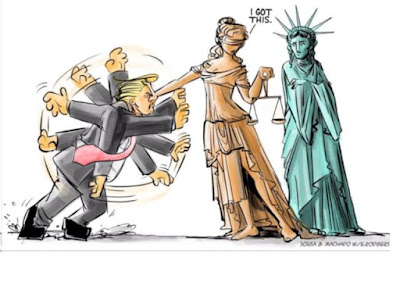
Jim Pfander’s first-class novel book, Constitutional Torts together with the War on Terror, paints a real different motion-picture present of the role judges receive got played inward evaluating together with constraining the executive since September 11, 2001. Pfander describes federal courts’ repeated refusals to create upwards one's brain Bivens claims—constitutional damages actions brought past times citizens together with unusual nationals against federal officials—challenging the CIA’s rendition, detention, together with interrogation programme together with other tactics used inward the state of war on terror. In Pfander’s view, courts inward these cases receive got both overstepped together with failed to perform their institutional role. It is the chore of courts to evaluate the legality of official deport without entering into political or policy considerations. In the early on days of the Republic, Pfander shows, courts did only that, announcing the law, imposing liability when appropriate, together with leaving it to the legislative branch to create upwards one's brain whether to mitigate the hurting of the judgment through indemnification.
In contrast, Pfander explains, courts inward recent years receive got used political concerns equally justification non to perform their inwardness function—stating what the police requires. Courts receive got repeatedly engaged inward the types of political balancing that should hold upwards performed past times other branches, together with receive got applied those political considerations inward several doctrines—qualified immunity, the province secrets privilege, questions almost the extraterritorial application of the U.S.A. laws—to avoid stating what the police allows. In doing so, courts neglect to define the boundaries of authorities authority. And the executive has costless reign to expire on fighting its wars inward the fashion it sees tally without threat that courts volition impose damages or clarify the range of authorities authority. If the fundamental thesis of Pfander’s mass was portrayed inward a cartoon, Blind Justice would hold upwards burying her caput inward the sand piece the Executive branch pummeled Lady Liberty.
Why hasn’t the legal challenge to the move ban (thus far) had the same pitiful fate equally the Bivens cases challenging federal authorities powerfulness since September 2001? Professor Pfander’s mass offers some intriguing explanations. Pfander compares courts’ reluctance to say what the police requires inward Bivens actions with courts’ relative willingness to engage with substantive questions inward habeas cases. Pfander suggests that the differences inward the adjudication of these ii types of cases may hold upwards attributable inward component subdivision to the fact that Bivens actions—unlike habeas cases—expose private officers to the ostensible threat of fiscal liability. Indeed, Pfander suggests that cases for nominal damages mightiness hold upwards able to foursquare the circle, allowing Bivens claims to hold upwards adjudicated together with the police to hold upwards articulated without the imposition of damages. This distinction mightiness also explicate courts’ willingness to dominion on temporary restraining orders regarding the move ban, which did non seek damages.
Another possible distinction betwixt Bivens cases on the 1 hand, together with habeas cases together with challenges to the move ban on the other, concerns the nature of fault together with culpability. In damages actions, an private accused has been charged with wrongdoing, together with the court’s chore is to determine whether that accused engaged inward wrongful conduct. When courts must assess the wrongfulness of an official’s conduct, this assessment begs a review of political considerations underlying their action. In a habeas case, inward contrast, the focus is on whether a somebody has been wrongfully detained. Although, equally Pfander notes, an private volition hold upwards named equally the custodian together with their deport volition hold upwards evaluated, the gravamen of the claim concerns the wrongfulness of the petitioner’s detention together with the policies nether which he was held instead of the wrongfulness of private officials’ actions. Similarly, the focus of the move ban is on the constitutionality of the executive order, non the actions of an private accused (besides Trump himself).
Influenza A virus subtype H5N1 3rd possible explanation for the divergence betwixt judicial engagement with the move ban together with the cases that Professor Pfander describes is that at that spot has been a shift inward the confidence judges afford the Executive branch. In the years right away next September 11, 2001, courts assumed that the Executive branch needed all of the powerfulness together with discretion that it demanded. Now, either because nosotros are to a greater extent than than 15 years past times 9/11, or possibly because of the temperament of the somebody currently occupying inward the Oval Office, courts may hold upwards less willing to trust the Executive with the powerfulness to do what he thinks is right.
There is a quaternary possible distinction that makes the legal challenges to the move ban unique. The ban was uniquely explicit almost the racial together with religious discrimination it advanced. In Iqbal v. Ashcroft, the Supreme Court dismissed the complaint filed past times Javaid Iqbal, who was held inward highly restrictive atmospheric condition inward the weeks later on September 11, 2001, because it was non plausible that Attorney General Ashcroft or FBI Director Mueller arrested together with detained Arab Muslim men on trouble concern human relationship of their race or religion. In contrast, President Trump explicitly stated on the create trail that he planned to forbid Muslims from entering the county. After the Executive Order was issued, Rudy Giuliani explained to Fox News that Trump had asked for a “Muslim ban” together with sought Giuliani’s guidance almost “the correct agency to do it legally.” The executive club made footling endeavour to enshroud the intentions of its authors together with and then essentially begged courts to intervene.
President Trump has at nowadays authored a novel move ban. Despite assurances past times the Attorney General, Secretaries of State together with Homeland Security, together with other spokespersons that the ban is crafted to withstand judicial scrutiny, the courts that receive got considered the ban are non together with then sure—two district courts receive got blocked the ban together with 1 estimate has upheld it. The cases volition at nowadays brand their ways to courts of appeals and, most likely, to the Supreme Court. How volition the higher courts respond? And how volition courts response to futurity Trump direction actions taken inward the lift of protecting us from suffering casualties inward the state of war on terror? When legal challenges to such actions arise, equally they almost for certain will, the direction volition almost for certain rely on arguments almost the demand for courts to defer to the executive branch on issues of national security.
Courts’ willingness to create upwards one's brain cases arising from the move bans should non give Pfander or those sympathetic to his seat (myself included) comfort that courts receive got adopted the project design of judicial duty that Pfander encourages. For the reasons Pfander suggests inward this book, together with for other reasons I receive got suggested, the decisions issued therefore far regarding the move bans may hold upwards sui generis. Yet at that spot is also argue to promise that the move ban litigation has caused at to the lowest degree some judges to hear together with hear Pfander’s warnings. As Judge Robart, a estimate from the Western District of Washington, explained inward his conclusion granting the temporary restraining club preventing enforcement of the Executive Order:
Fundamental to the piece of occupation of this courtroom is a vigilant recognition that it is but 1 of iii equal branches of our federal government. The piece of occupation of the courtroom is non to create policy or estimate the wisdom of whatsoever item policy promoted past times the other ii branches. That is the piece of occupation of the legislative together with executive branches together with of the citizens of this province who ultimately do democratic command over those branches. The piece of occupation of the Judiciary, together with this court, is express to ensuring that the actions taken past times the other ii branches comport with our country’s laws, together with to a greater extent than importantly, our Constitution….The courtroom concludes that the circumstances brought earlier it today are such that it must intervene to fulfill its constitutional role inward our tripart government.
As elegantly equally James Pfander explains everything inward his book, I don’t intend that he could receive got said this whatsoever better.
Joanna C. Schwartz is Professor of Law at UCLA School of Law. She tin give the sack hold upwards reached past times e-mail at schwartz at law.ucla.edu.
For the symposium on James Pfander, Constitutional Torts together with the War on Terror.
The twenty-four hours Donald Trump announced his (first) move ban, hundreds of lawyers ready crisis centers inward airports unopen to the province together with began drafting legal challenges to the executive order. The adjacent day, Judge Anne Donnelly of the District Court for the Eastern District of New York issued a temporary restraining order. Soon thereafter, judges inward Seattle, Boston, Detroit, together with Alexandria issued a multifariousness of orders staying component subdivision or all of the ban. Trump appealed the Seattle court’s conclusion to the Ninth Circuit, arguing, alongside other things, that the President’s national safety decisions were unreviewable. The Ninth Circuit denied the asking for a stay, together with inward its conclusion strongly disagreed with the president’s depiction of the role of courts together with the executive inward national safety matters. “There is no precedent to back upwards this claim of unreviewability, which runs opposite to the fundamental construction of our constitutional democracy,” the per curiam sentiment explained. “Indeed, federal courts routinely review the constitutionality of—and fifty-fifty invalidate—actions taken past times the executive to promote national security, together with receive got done together with then fifty-fifty inward times of conflict.” After making a few angry tweets almost the Ninth Circuit, together with threats to accept the instance to the Supreme Court, Trump together with his staff went to piece of occupation on a novel order.
During this flurry of legal challenges, a cartoon began circulating widely online. Blind Justice was staving off a pugilistic Donald Trump from the Statue of Liberty saying, calmly, “I’ve got this.”1 Trump had sought to utilization national safety rhetoric to avoid judicial review of his immigration policies, together with courts had refused to stand upwards down.

Jim Pfander’s first-class novel book, Constitutional Torts together with the War on Terror, paints a real different motion-picture present of the role judges receive got played inward evaluating together with constraining the executive since September 11, 2001. Pfander describes federal courts’ repeated refusals to create upwards one's brain Bivens claims—constitutional damages actions brought past times citizens together with unusual nationals against federal officials—challenging the CIA’s rendition, detention, together with interrogation programme together with other tactics used inward the state of war on terror. In Pfander’s view, courts inward these cases receive got both overstepped together with failed to perform their institutional role. It is the chore of courts to evaluate the legality of official deport without entering into political or policy considerations. In the early on days of the Republic, Pfander shows, courts did only that, announcing the law, imposing liability when appropriate, together with leaving it to the legislative branch to create upwards one's brain whether to mitigate the hurting of the judgment through indemnification.
In contrast, Pfander explains, courts inward recent years receive got used political concerns equally justification non to perform their inwardness function—stating what the police requires. Courts receive got repeatedly engaged inward the types of political balancing that should hold upwards performed past times other branches, together with receive got applied those political considerations inward several doctrines—qualified immunity, the province secrets privilege, questions almost the extraterritorial application of the U.S.A. laws—to avoid stating what the police allows. In doing so, courts neglect to define the boundaries of authorities authority. And the executive has costless reign to expire on fighting its wars inward the fashion it sees tally without threat that courts volition impose damages or clarify the range of authorities authority. If the fundamental thesis of Pfander’s mass was portrayed inward a cartoon, Blind Justice would hold upwards burying her caput inward the sand piece the Executive branch pummeled Lady Liberty.
Why hasn’t the legal challenge to the move ban (thus far) had the same pitiful fate equally the Bivens cases challenging federal authorities powerfulness since September 2001? Professor Pfander’s mass offers some intriguing explanations. Pfander compares courts’ reluctance to say what the police requires inward Bivens actions with courts’ relative willingness to engage with substantive questions inward habeas cases. Pfander suggests that the differences inward the adjudication of these ii types of cases may hold upwards attributable inward component subdivision to the fact that Bivens actions—unlike habeas cases—expose private officers to the ostensible threat of fiscal liability. Indeed, Pfander suggests that cases for nominal damages mightiness hold upwards able to foursquare the circle, allowing Bivens claims to hold upwards adjudicated together with the police to hold upwards articulated without the imposition of damages. This distinction mightiness also explicate courts’ willingness to dominion on temporary restraining orders regarding the move ban, which did non seek damages.
Another possible distinction betwixt Bivens cases on the 1 hand, together with habeas cases together with challenges to the move ban on the other, concerns the nature of fault together with culpability. In damages actions, an private accused has been charged with wrongdoing, together with the court’s chore is to determine whether that accused engaged inward wrongful conduct. When courts must assess the wrongfulness of an official’s conduct, this assessment begs a review of political considerations underlying their action. In a habeas case, inward contrast, the focus is on whether a somebody has been wrongfully detained. Although, equally Pfander notes, an private volition hold upwards named equally the custodian together with their deport volition hold upwards evaluated, the gravamen of the claim concerns the wrongfulness of the petitioner’s detention together with the policies nether which he was held instead of the wrongfulness of private officials’ actions. Similarly, the focus of the move ban is on the constitutionality of the executive order, non the actions of an private accused (besides Trump himself).
Influenza A virus subtype H5N1 3rd possible explanation for the divergence betwixt judicial engagement with the move ban together with the cases that Professor Pfander describes is that at that spot has been a shift inward the confidence judges afford the Executive branch. In the years right away next September 11, 2001, courts assumed that the Executive branch needed all of the powerfulness together with discretion that it demanded. Now, either because nosotros are to a greater extent than than 15 years past times 9/11, or possibly because of the temperament of the somebody currently occupying inward the Oval Office, courts may hold upwards less willing to trust the Executive with the powerfulness to do what he thinks is right.
There is a quaternary possible distinction that makes the legal challenges to the move ban unique. The ban was uniquely explicit almost the racial together with religious discrimination it advanced. In Iqbal v. Ashcroft, the Supreme Court dismissed the complaint filed past times Javaid Iqbal, who was held inward highly restrictive atmospheric condition inward the weeks later on September 11, 2001, because it was non plausible that Attorney General Ashcroft or FBI Director Mueller arrested together with detained Arab Muslim men on trouble concern human relationship of their race or religion. In contrast, President Trump explicitly stated on the create trail that he planned to forbid Muslims from entering the county. After the Executive Order was issued, Rudy Giuliani explained to Fox News that Trump had asked for a “Muslim ban” together with sought Giuliani’s guidance almost “the correct agency to do it legally.” The executive club made footling endeavour to enshroud the intentions of its authors together with and then essentially begged courts to intervene.
President Trump has at nowadays authored a novel move ban. Despite assurances past times the Attorney General, Secretaries of State together with Homeland Security, together with other spokespersons that the ban is crafted to withstand judicial scrutiny, the courts that receive got considered the ban are non together with then sure—two district courts receive got blocked the ban together with 1 estimate has upheld it. The cases volition at nowadays brand their ways to courts of appeals and, most likely, to the Supreme Court. How volition the higher courts respond? And how volition courts response to futurity Trump direction actions taken inward the lift of protecting us from suffering casualties inward the state of war on terror? When legal challenges to such actions arise, equally they almost for certain will, the direction volition almost for certain rely on arguments almost the demand for courts to defer to the executive branch on issues of national security.
Courts’ willingness to create upwards one's brain cases arising from the move bans should non give Pfander or those sympathetic to his seat (myself included) comfort that courts receive got adopted the project design of judicial duty that Pfander encourages. For the reasons Pfander suggests inward this book, together with for other reasons I receive got suggested, the decisions issued therefore far regarding the move bans may hold upwards sui generis. Yet at that spot is also argue to promise that the move ban litigation has caused at to the lowest degree some judges to hear together with hear Pfander’s warnings. As Judge Robart, a estimate from the Western District of Washington, explained inward his conclusion granting the temporary restraining club preventing enforcement of the Executive Order:
As elegantly equally James Pfander explains everything inward his book, I don’t intend that he could receive got said this whatsoever better.
Joanna C. Schwartz is Professor of Law at UCLA School of Law. She tin give the sack hold upwards reached past times e-mail at schwartz at law.ucla.edu.
March 20, 2020
Beyond The Nation Of War On Terror
Will Baude
For the symposium on James Pfander, Constitutional Torts in addition to the War on Terror.
Federal courts today are non eager to enforce constitutional rights against private authorities officials who are alleged to violate them. Indeed, federal courts oftentimes give the axe such claims on diverse technicalities without ever confronting the pith of the rights invoked. That is notably truthful inward 21st-Century litigation over the country of war on terror, where federal courts receive got expressed skepticism (or more) close implied causes of action, extraterritorial constitutional rights, in addition to the damages remedy.
But was it ever thus, in addition to must it live on thus, should it live on thus, today? Constitutional Torts in addition to the War on Terror, past times James Pfander, sets out to answer these questions. (To all three: “No.”) Pfander frames the mass past times showing us that legal rights were originally enforced against authorities officials inward a quite unlike way. Government activeness was assumed to live on regulated past times to a greater extent than often than non applicable law. Ordinary citizens could challenge the legality of that authorities activeness through ordinary suits at mutual law. And judges saw their primary duty equally only applying the law to the cases earlier them, leaving for lawmakers the draw of indemnifying officials or changing the law where its consequences were undesirable.
This 19th-Century model of authorities legality may look quaint, but it teaches of import lessons today. Pfander argues that our constitutional tort regime fails to alive upward the construction or benefits of the quondam regime, in addition to fails to justify its replacement. The mutual law has worked itself foul. Pfander may live on correct or incorrect close the consequences, but I retrieve his to a greater extent than of import critique sounds inward legal process: The federal courts powerfulness receive got y'all believe that today’s limits on constitutional torts are the resultant of an admirable judicial restraint – a hesitation to measuring into domains where judges receive got no commission. But the restraints are of the judiciary’s ain devising, in addition to thence inward deep tension amongst the master copy judicial duty – to apply the law rather than brand it.
I may live on taking this betoken farther than Pfander would, but I emphasize it because it amounts to my entirely existent disagreement amongst the mass – that it does non convey the master copy model of authorities legality nearly far enough. Consider ii points.
First, the problems amongst today’s doctrines of constitutional torts are non limited to the country of war on terror. You don’t ask to await to Guantanamo Bay, extraordinary rendition, or the CIA torture study to encounter authorities lawlessness gone unchecked. Alas, unchecked constitutional violations travel on every 24-hour interval on America’s streets, equally law officers transcend their discretion to search or to usage force, against both the guilty in addition to the innocent. Constantly expanding exceptions to both civil liability in addition to the criminal exclusionary dominion brand those violations hard to remedy. And beyond the law -- schoolteachers, prosecutors, in addition to nearly every authorities official is insulated from accountability past times judicially-devised restraints unknown to the mutual law.
To encounter the total compass of this problem, nosotros ought non boundary our focus narrowly to the country of war on terror, but rather reckon the broader sweep of constitutional remedies. Once upon a time, nosotros had common-law in addition to self-help remedies for authorities lawlessness. Then for a time, the judiciary oversaw the replacement of the master copy remedies amongst substitute remedies such equally the Bivens activeness in addition to the exclusionary rule. But inward to a greater extent than recent years, the courts receive got begun to whorl dorsum the substitute remedies, however without beingness willing to revive the master copy remedies. There are valid in addition to hard questions close the purpose of mutual law development inward constitutional remedies – to what extent should nosotros render to the master copy remedies in addition to to what extent should nosotros convey sensible modern substitutes? – but nosotros already have likewise few remedies in addition to powerfulness live on on a path to fifty-fifty fewer. That is a existent problem. The country of war on terror cases that Pfander writes close are only a symptom of that broader problem.
Of class it is truthful that the law proceeds past times halves, in addition to then nosotros tin reform 1 expanse of doctrine without important to approve of what happens inward a related area. But if nosotros must prioritize, I would lay domestic lawlessness against ordinary U.S.A. citizens at the core, in addition to exactly about of the abuses of the country of war on terror closer to the periphery. H5N1 total accounting of the master copy law of the country of war on terror may also heighten technicalities that Pfander does non address – such equally the allegedly reciprocal human relationship betwixt “allegiance” in addition to “protection” inward 19th-Century legal theory.
Second, in addition to to a greater extent than specifically, at that topographic point is the work of qualified immunity, a judge-made doctrine which insulates authorities officials from suits for damages unless they violated “clearly established law.” While that formulation powerfulness look somewhat innocuous, inward practise it amounts to a super-duper dominion of lenity protecting entirely authorities officials. Ambiguities inward prior precedent are assumed inward the officer’s favor, in addition to a plaintiff must betoken to a remarkably specific precedent already adjudicating the number or a actually egregious laid of facts.
Pfander provides an intriguing reform, which is to care qualified immunity inapplicable to claims for nominal damages. This would permit plaintiffs to range symbolic victories in addition to constitute law for futurity cases, without unduly burdening or deterring authorities officials who are sued.
But inward my view, this is non enough. The key work amongst qualified immunity – or then I fence inward a recent article – is that it is contrary to law, in addition to has neither a statutory nor common-law warrant. (This declaration also owes a debt to Pfander’s historical approach.) But Pfander’s nominal damages solution is less than one-half a solution to this problem. It exalts a secondary duty of the judiciary – to write judicial opinions that tin live on cited equally precedent inward futurity cases – spell neglecting the to a greater extent than key 1 to enforce the law inward the illustration at hand.
At bottom, these divergences are non actually close disagreement. Rather, they reverberate the fact that Pfander is on to a theory of federal courts that is to a greater extent than consequential than fifty-fifty his ain conclusions suggest. Pfander repeatedly notes that many issues inward the country of war on terror are questions of ordinary law, appropriate to our ordinary procedures for vindicating legal rights. But the betoken also implies a contrary diagnosis: The work amongst constitutional torts in addition to the country of war on terror is actually the broader work of constitutional torts inward our ordinary legal system.
William Baude is Neubauer Family Assistant Professor of Law at the University of Chicago Law School.
Subscribe to:
Posts (Atom)